


The Future of REST Part 3: Announcing a Change in Leadership

The last blog in our series is one that hits closer to home for me. Twelve years ago, I felt a calling in my spirit to start REST. I knew it would require sacrifice, bring joy, and take over my life. I was scared but said yes. I could not have imagined that we would grow to build out a continuum of care serving over 600 survivors a year. And now that REST has adopted a new mission to expand pathways to freedom, safety, and hope in order to end sex trafficking, with specific opportunities to multiply impact across the United States, I believe it is the right time for a new leader to step in as Executive Director. 

While it will be a significant change for me to step out of the Executive Director role, I am confident this is a strategic move for our mission. I will be joining REST’s Board of Directors to initiate and help drive national impact projects and partnerships forward. This new seat will be the best way to leverage my strengths for our next phase of growth. There are three reasons why I think this is the right move.

First, at my core I am a builder and an entrepreneur, bringing new ideas to life in order to create meaningful impact. I’m wired to steer toward strategy, fast growth, and impact, which has served us well so far, though I recognize at times it has put a strain on our team and our systems to grow so quickly. This next stage for REST, as it would be for any organization at this stage of its life cycle, is to have steady upward growth through incremental change, maintaining and upgrading, and refining. REST deserves a leader who is wired for this type of growth, ideally someone who has experience growing an organization of our size to the next level with both sustainability and impact.

Second, I have prioritized reputation and credibility over awareness, but all are important. We will maintain thoughtfulness and quality in our approach, but it’s time for the mission of REST to have a leader who is eager to be the face of the organization and build stronger communications and public relations activities so that we can expand our reach and draw more people into our work. This is an essential part of the next season for REST and I know this is just not how I am wired. I’m excited for us to have an Executive Director who naturally seeks out and creates more opportunities to tell the story of REST.

Third, it’s natural for an organization to experience “founder syndrome” where the founder becomes a central knowledge source and we start to get stuck in the ways we’ve always done things. Stepping aside opens the door for new ideas, new systems, and new opportunities for courageous leadership and decision-making to flourish throughout the organization. By joining the Board I can still provide continuity of leadership and be ready to fuel those new ideas with support and strategy. 

It has taken me some time to reach this decision and I am at a place where I feel great about what this will mean for REST and for me. The Board of Directors has been supportive and agrees with the benefit of this move for the organization. You can read a note from the Board to learn more about their perspective on the transition. 

The Board has initiated a search committee and will be working with a firm to implement a national search for our next Executive Director, which we anticipate will take about six months. I will remain in the position until our next Executive Director is in place.

To all of REST’s partners, supporters, employees, and volunteers - you have made the work of REST possible and it has been my deepest honor to walk alongside all of you, and the survivors who have entrusted us with their care. As we prepare to expand our reach and multiply our impact, it is a perfect time for all of us to deepen our investment with REST and advance the mission. Together we will expand pathways to freedom, safety, and hope in order to end sex trafficking. Because everyone is worthy of love and deserves to live a life without exploitation.

Amanda Hightower
Founder & Executive Director
The Future of REST Part 2: Our Plan to Expand Pathways

What would it mean for REST to eradicate systems of harm, rather than merely treat symptoms of harmful systems? This was the question posed to us by LTHJ Global, a local DEI Consulting firm, who led us through an initiative to imbed diversity, equity, inclusion, and access throughout our culture and practices at REST in 2020-2021. 

We spent several months last year, gathering feedback from stakeholders to inform our strategic plan. We interviewed survivors, REST clients, other service providers, community partners, supporters, and national leaders in the anti-trafficking field. Our question: If we were going to end sex trafficking by 2040, what needs to happen? And what role should REST play?  

It may not be realistic to end sex trafficking by 2040, and that’s okay. The question was meant to guide us toward the activities that would have the highest impact. Economic inequality & poverty emerged as the most significant system of oppression that contributes to sex trafficking. When asked what activities REST should contribute to disrupting or dismantling the system of economic inequality & poverty, respondents said, in this priority: 

  1. Survivor Services

  2. Education

  3. Awareness & Culture Change

  4. Policy Advocacy

The strategic plan for REST mirrors these priorities and will guide our expansion in three ways over the next five years. 

1. Going Multi-Site with Survivor Services

Everyone is worthy of love and deserves to live a life without exploitation. This underlying belief continues to fuel everything we do at REST, so direct service work with victims and survivors of sex trafficking will remain core to our work. We also believe that services with survivors are a strategic way to help end sex trafficking. A group of survivors who recover from trafficking and use their voice and experience to advocate for policy change and influence culture can significantly propel the effort to end sex trafficking in the United States. 

Based on a decade of gathering feedback from survivors who have accessed services at REST, we have confidence in the impact of our service model and will prioritize investing in services that consistently deliver the greatest long-term impact. We will also identify another city (or two) within the United States to replicate our service model and demonstrate that positive outcomes are not geographically dependent. This will not only give us the opportunity to serve more survivors in places where there is the greatest need, but it will also set REST up to have greater influence with policymakers.

2. Launching a Training & Technical Assistance Division

In 2023 we plan to launch a training and technical assistance program to build capacity with other direct service providers across the country. We envision providing training and consultation with 100 providers over the next five years, multiplying our impact by strengthening the teams who are providing critical services and partnering with them to enhance their work with survivors. Two features of our curriculum include Motivational Interviewing Informed Wraparound (MiiWrap), an evidence-based approach to care, and a uniquely designed Impact Management process that supports continuous improvement and highlights the long-term impacts of services.

This won’t be an entirely new activity for us, as we’ve frequently mentored and walked alongside other nonprofits to share promising practices and learn from their expertise as well. In fact, we currently get multiple requests each week for training and consultation. With this new division, we will build dedicated resources and staff so we can say yes. 

3. Building Strategic Partnerships for High Impact Projects  

The final pillar in our plan, which is estimated to launch in 2-3 years, is to expand strategic partnerships, focusing on developing and supporting national initiatives that will help end sex trafficking. Through this effort, we hope to work with new and existing partners to implement unique projects that are likely to contribute to the end of sex trafficking. This may include technology projects, like TIRA (an app we developed with volunteers from Microsoft and UW), policy advocacy initiatives, working with influencers to accelerate awareness of human trafficking, and driving culture change through marketing and media campaigns. 

The litmus test for any partnership or any activity we engage in is this: will it contribute to the end of sex trafficking? 

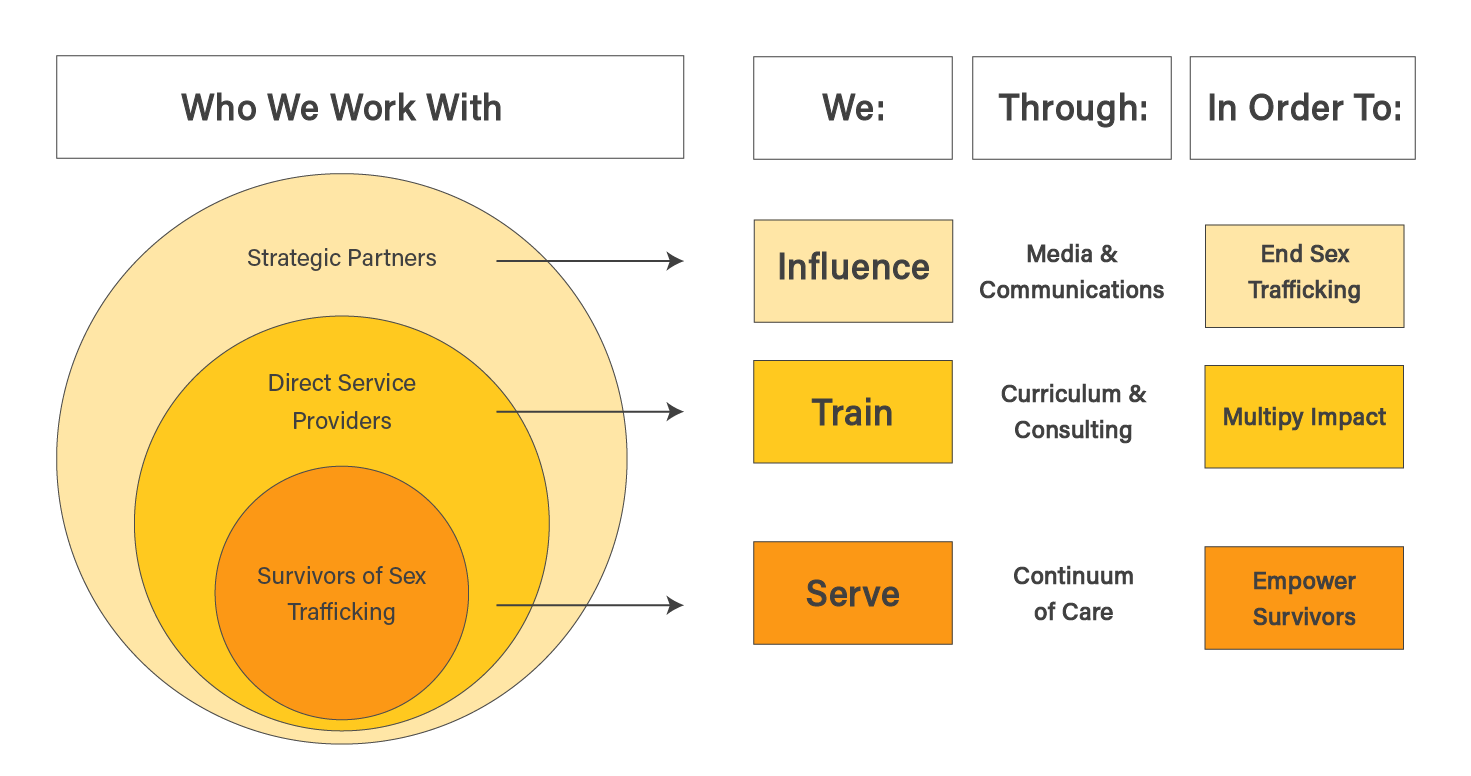
Here’s a visual of our strategic plan framework as we move forward. 

We want to give a special thanks to The Jensen Project who provided REST with a grant to fund our strategic planning process, and Stacey Pearson, with the Paterson Center, who led REST leadership through a three-day StratOp process, which enabled us to formulate this 5-year strategic plan. We are grateful and excited for the future of REST.

The Future of REST Part 1: A Change to our Mission Statement

The work of REST began on the streets of Seattle, building relationships with people involved in the sex trade, the majority of whom were being trafficked. In theory, we had a simple objective: build trust, ask what they need, and make sure they get it. And if we discovered that what they needed didn’t exist or didn’t work, we committed to building it. In practice, we learned that very few services were designed to meet the needs of survivors of trafficking and failed to accommodate for the, often, years of complex trauma they’ve endured. 

We ended up building. A lot. 

Thirteen years later, we’ve built one of the largest continuum of services designed by and dedicated for victims and survivors of sex trafficking in the United States. Over 600 individuals engage with REST each year, and more than 400 of them enroll in one or more of our services like emergency shelter, community-based advocacy, behavioral health, economic empowerment, transitional housing, or permanent housing. Our impact measurement model enables us to implement continuous improvement within our services and ensure survivors have the greatest opportunity to recover from trafficking and achieve their goals. 

We successfully advanced our founding mission to provide pathways to freedom, safety, and hope for victims of sex trafficking and people involved in the sex trade. 

Given our history of successful growth, it might surprise you then to know that we embarked on a strategic planning initiative to ask ourselves if we were doing the right things. We wanted to consider our way forward in light of a community-first approach to nonprofit leadership, in which we believe that a nonprofit exists to eradicate systems of harm, rather than merely treat symptoms of harmful systems. This is not a new approach for us, but it was helpful to step back and ask if we were still on the right path and operating with an obvious long-term objective for the organization. This led us to unanimously simplify and embolden our mission statement, which now reads: 

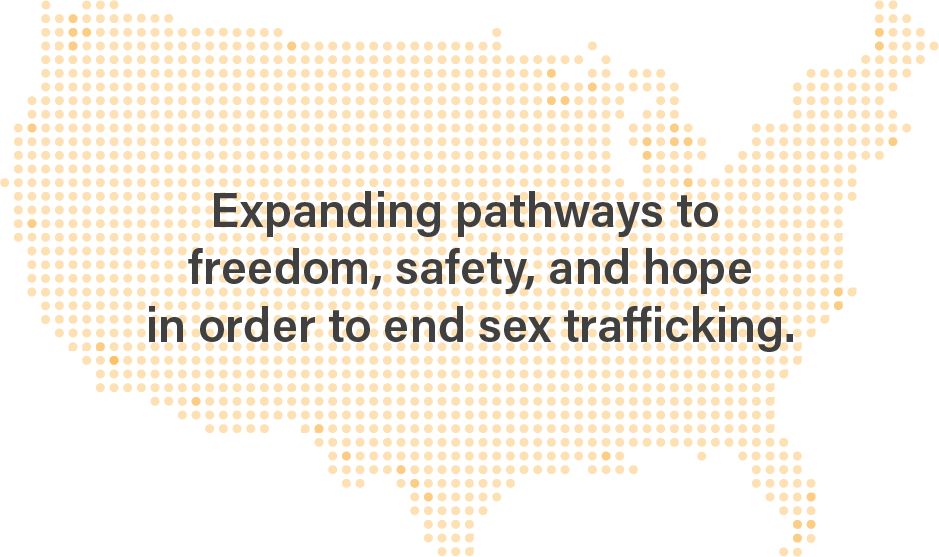
REST exists to expand pathways to freedom, safety, and hope in order to end sex trafficking. 

Did you feel a little spark ignite in your spirit? We feel it too!

There are three important changes we want to highlight: 

  1. We changed the word “provide” to “expand” in order to emphasize a multiplying effect as we work with partners and other organizations around the country to expand pathways to freedom, safety, and hope. 

  2. We removed specific language about the “who” we provide pathways for in order to create space for strategic activities that we believe will contribute to the end of sex trafficking but are not specifically direct service efforts. 

  3. We added a clear, bold, and long-term aim for REST: to end sex trafficking. This will act as a litmus test for all of our work as we move forward and multiply our impact. We must be certain that our services, our partnerships, and our projects contribute to the end of sex trafficking. 

The important things will stay the same.

We will continue providing direct services with survivors as our core work, and our Statement of Faith and organizational values will carry us forward. Our underlying belief that everyone is worthy of love and deserves to live a life without exploitation continues to be the heartbeat of REST and will guide us in how we expand pathways to freedom, safety, and hope in order to end sex trafficking.

Huge thanks to everyone who helped inform the future of REST!

Thank you to Lindsey T.H. Jackson, Founder and CEO of DEI Consulting Firm, LTHJ Global, Inc, who led REST through a 9-month initiative to embed diversity, equity, and inclusion throughout the organization. It was Lindsey’s guidance about community-first nonprofits that reminded us of our roots and launched us into a strategic planning initiative.

Thank you to the dozens of survivors, employees, partners, donors, and community members who weighed in via interviews, focus groups, and surveys to share their recommendations for the future of REST.

Thank you to Janet Jensen with The Jensen Project, for providing REST Leadership with a grant to participate in a STRATOP process to clarify our purpose and build out our strategic plan.

Thank you to all of those who lifted REST up in prayer as we considered our path forward.

Coming up next: The Future of REST Part 2: Expanding Pathways. The next blog in our series will highlight our newly adopted five-year strategic plan and how we hope to multiply our impact. 

What makes us look the other way?

by Shama Shams, Director of Philanthropy & Marketing and a Survivor

A couple of weeks ago a video surfaced from a surveillance camera on Aurora Avenue.   It appeared that a young woman was being physically abused by a man.  This woman was in the middle of the street when he approached her and knocked her down to the pavement as he kicked and punched her repeatedly.

Car after car approached the intersection where this abuse was taking place and turned away.  No one got out of the car to offer help during this three-minute video footage.   

The term “bystander intervention” describes a situation where someone who isn’t directly involved steps in to change the outcome. Stepping in may give the person of concern a chance to get to a safe place or leave the situation.  

As I watched the video, I found myself wondering why no one stopped to lend a hand.  As a survivor of physical and sexual abuse, that question came to my mind countless times a question not just directed to strangers, but to my own family members as well. So many people knew and even witnessed my abuse, but allowed it to continue. What makes us look the other way?

In 1964, Kitty Genovese was arriving home from work in the middle of the night when she was brutally stabbed to death while several of her neighbors looked on.  This incident led to the coining of the term “bystander effect” – a phenomenon within social psychology that describes how people are less likely to offer help to a victim when other people are present.  

After Genovese’s murder, there was a widespread public condemnation of the witnesses who did not come to Kitty Genovese’s aid. The incident also gave rise to an entire area of psychological research to determine why some bystanders help and why others do not.

According to the U.S. Department of Justice, a bystander is present in 70 percent of assaults and 52 percent of robberies. The percentage of people who help a victim varies widely by the type of crime, the environment, and other key variables.

A well-known study found that when bystanders were alone, 75 percent helped when they thought a person was in trouble. However, when a group of six people was together, only 31 percent helped.

Being part of a group often diminishes one’s sense of personal responsibility. Instead, there’s a feeling of anonymity. In this state, people are more likely to do things they would never do individually. 

Common reasons for not coming to the aid of a victim include:

  • fear that the personal risk of harm is too great

  • feeling that one doesn’t have the strength or other traits needed in order to be able to help

  • assuming that others are better qualified to help

  • watching the reactions of other witnesses and assuming the situation is not as serious as you initially thought because they don’t seem alarmed

  • or fear becoming the target of aggression or bullying

The bystander effect has become one of the most well-recognized concepts in modern psychology. And it extends far beyond how people behave in an emergency. In just about any group situation requiring one person to step forward to accomplish something necessary, there is often a delay while members of the group decide who will be the volunteer who will act. 

In the volunteer’s dilemma, a mutually beneficial outcome will result from one person doing a relatively unpleasant task while the others simply benefit without doing anything. This means that each member of the group needs to decide on whether to be the one to step forward or not.

Much like the bystander effect, the time needed to decide who will volunteer rises depending on how many volunteers there are in the group. If there are only two volunteers, then it quickly devolves into a game of "you do it, no you do it" (a familiar enough scenario in real life).

The next time you find yourself in a situation agonizing over who will do something, think about the bystander effect and the volunteer's dilemma. Sometimes, all it takes is one person willing to act.